

There is a Balm in Gilead to make the wounded whole, There is a Balm in Gilead to heal the sin-sick soul [African American spiritual]
Once, when I was a child, I ran briefly away from home. I got no farther than the wooded ravine on the far side of Salisbury Road, two blocks from my house. There I stayed for an hour or so, with my little backpack filled with a book and a sandwich, reading and eating until I realized I should probably get home.
Sixty years later, I still have that impulse to find a hideaway, or a refuge, a place of comfort. There’s a small mountain near me—modest, even by Adirondack standards, only a 600 foot ascent to 2400 feet. It’s called Balm of Gilead and I walk there often, in every season. It is ordinary in the quietly beautiful way of these woods, comforting in its familiarity, and yet, each day, I sense something new.
It’s a short walk from my house to a trailhead that leads to Balm of Gilead—down the pressed down dirt of Old Farm Road to the edge of the Siamese Ponds Wilderness Area. Here Old Farm Road becomes Old Farm Trail, a path that once led to logging camps and a remote farm. In the dense woods, thick with undergrowth, it’s hard to imagine this wilderness area was once clear-cut, that an 19th-century wanderer would have seen an entirely different place.
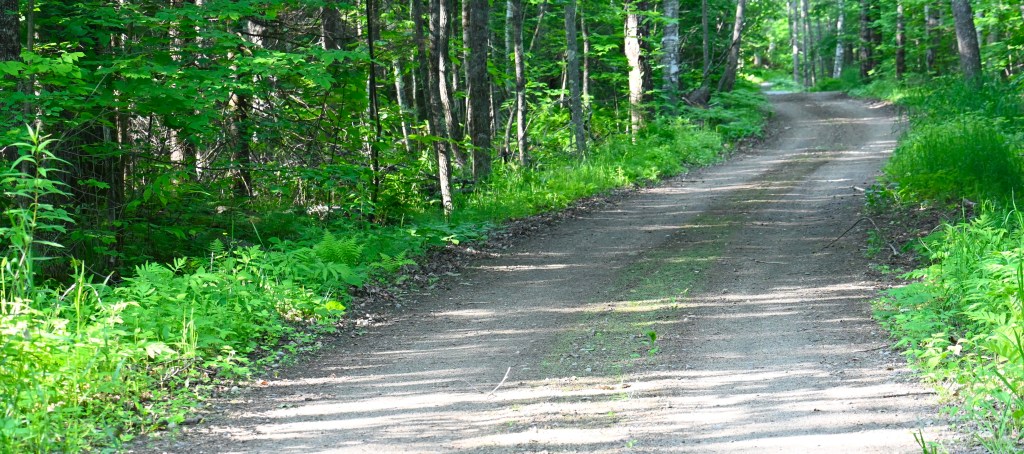
Old Farm Trail stays relatively flat for all of its length, with a few undulating turns over the inevitable streams. A short way into the Wilderness Area, is the trail kiosk, the place for sign-ins and lost hats and gloves.

You turn left off Old Farm Trail, which at this point is still wide enough for the horse-drawn carriages that once came through.


The trail quickly becomes uneven and rutted. In the spring, large swathes of it are nearly impassable, having turned into ephemeral pools that might last into July in a rainy year. The pools recede, leaving mud and thick roots. Eventually the trail evens out but not without a few small stream crossings over log bridges.

Eight-tenths of a mile in, the trail up to the summit branches off to the right. OK, technically, the trail ends at a false summit, the real summit visible slightly to the south. But though it may be a false summit, the rocky outcropping at the end of the trail is worth the occasionally steep scramble over boulders and logs.


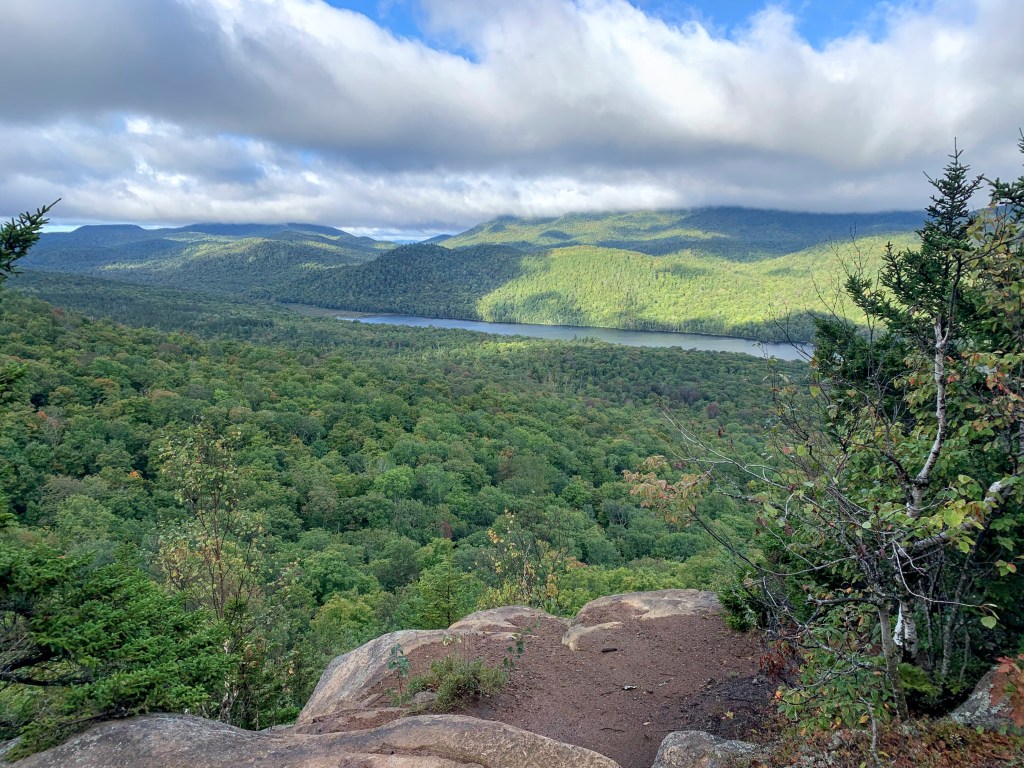
Eventually, the woods part and a new expansive vision appears before you.


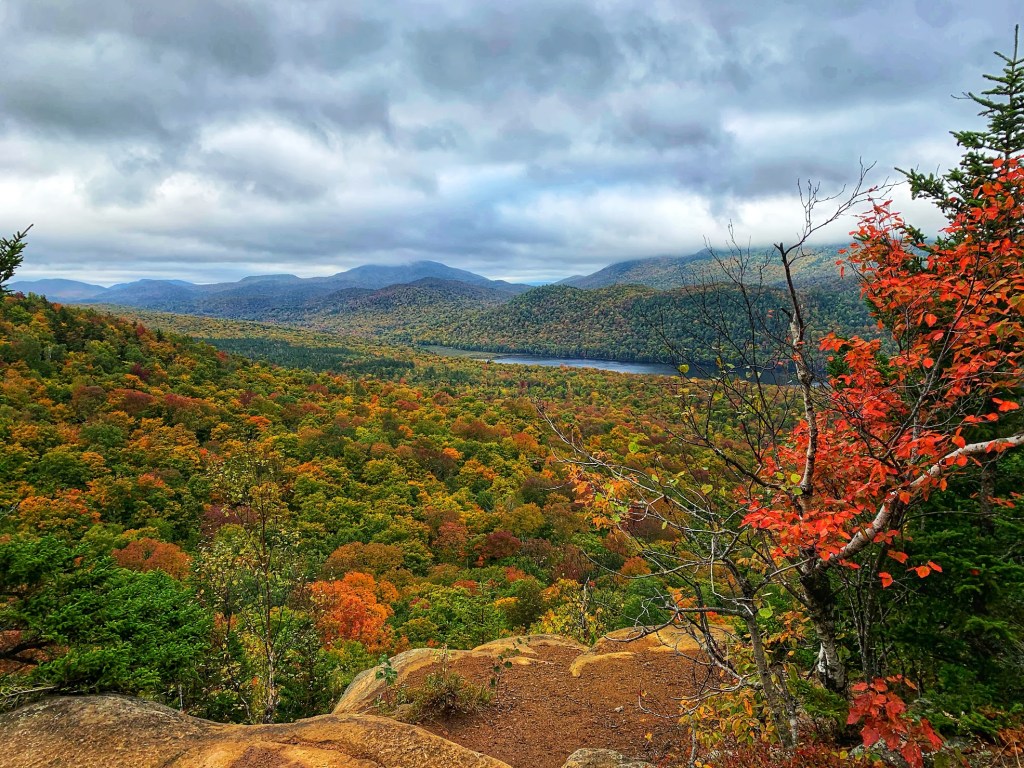
Below you is Thirteenth Lake, and beyond the water, the low-slung mountains that circle it—Little Thirteenth Lake Mountain, Hour Pond, Mountain, Peaked Mountain. From the top, you can see the arboreal legacy of the old farm, the patch of the woods that stays dark green all winter as the firs and pines took over the Old Farm Clearing when the loggers left.

Most days, I have the trail nearly to myself. This is a tranquil, almost backwater, part of the Adirondacks, free from the crowds of the High Peaks or Lake George. The busiest time on Old Farm Trail is in the fall, when the hunters come with their camouflage and rifles, the parking lot then jam-packed with pickup trucks. In the summer, I run into visitors to Garnet Hill Lodge, who have come in from the old Hooper Garnet Mine.
I walk it in the winter with snowshoes, the packed-down snow creating a thick layer over the mottled trail below. In early spring, I watch as the sheen of ice slowly dissolves into the puddles, the trail turns to mud with the melting snow, and later as the spotted yellow trout lilies appear as harbingers of spring with the fluorescent green of new leaves soon to follow.

In the spring, the streams that flow off the mountain toward the Hudson River are rushing and I balance myself with hiking poles as I cross over the logs.
The view from the summit is never quite the same. Sun glows from behind blue-gray clouds, the pink of sunset colors the lake and in the autumn, a breathtaking display of oranges and reds in every shade. In the winter, the landscape is gray and white with spikes of evergreen.
I don’t know how Balm of Gilead got its name. I don’t know what the Kanienʼkehá꞉ka (Mohawk) people called it. The original surveyor of the Adirondacks, Verplank Colvin, called it Balm of Gilead in the 1870s but who knows why. Perhaps it was for balsam poplars that once grew nearby, sending out the sharp scent of resin.
I prefer to imagine a nineteenth century preacher, who got to the top of the mountain on a blustery day, or perhaps feeling the suffering of his parishioners, and called out the name of the Prophet Jeremiah: Is there no balm in Gilead? Can no physician be found? Why has healing not come to my poor people? [Jeremiah 8:22].

Perhaps being at the top of that mountain, accessible and yet lofty, she felt the presence of something sacred. Being on a mountaintop is a balm for the spirit. It is impossible not to be moved. It’s still there, waiting.

 Old and On the Way
Beautiful! Thank you.
LikeLike
Thank you for reading!
LikeLike
Sharon, so beautifully spiritual . Reads like a meditation. What a perfect sanctuary . I’m thinkin’, I’m 72 snd not in the best of shape to traverse those trails but your soulful post made it accessible!
LikeLike
Thanks Roberta-and come visit me and we’ll see what we can of these mountains
LikeLike
Gracias, Sharon. Una caminata glorioso. Pude imaginarme caminando contigo.
Parece un lugar mágico.
LikeLike
Mil gracias por haberlo leído. Ven a visitarme en el campo!
LikeLike
What a wonderful area! And, I love that song.
LikeLike
Thank you. Funny you say that-I listened to the version with Mahalia Jackson while I was writing and was literally moved to tears
LikeLike
Lovely description 😎👍
LikeLike
Thanks! You know of what I speak.
LikeLike
Thank you for this. It is wonderful, and an honor, to get to know a place in all seasons and all times of day and evening. So beautiful, thanks for sharing your runaway spot.
LikeLike
Thanks Nancy. I hope you can experience the Adirondacks with me some day!
LikeLiked by 1 person
Nice to meet you, Sharon. If you are interested in the balm of Gilead, you might be interested in “The Teachings of Gilead” (1960-2005) @ thebibledecoded.com
LikeLike