

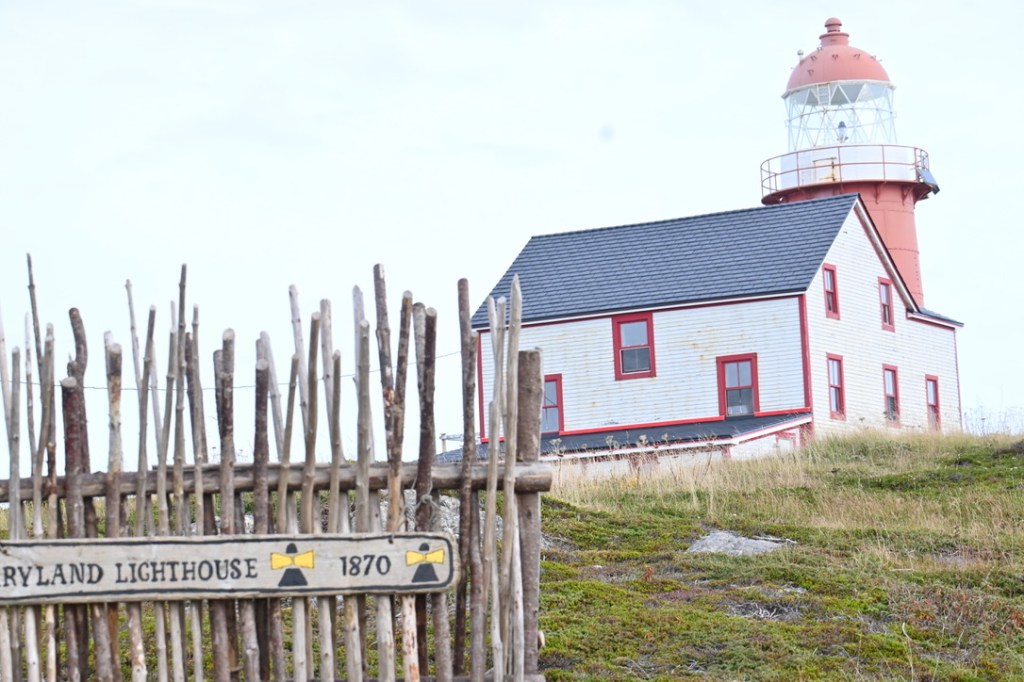
On the only sunny day of my six days in Newfoundland, I drove down the Irish Loop from St. Johns to Ferryland, a town founded in 1621. Ferryland sits halfway down the east coast of the Avalon Peninsula, nestled, like so many Newfoundland towns, in a cove framed by rocky cliffs. In mid-October, I parked near the now-closed visitor center and began the mile and a half walk toward the Ferryland lighthouse, at the end of a spit of land that starts narrow and then widens into a high rounded bulb.
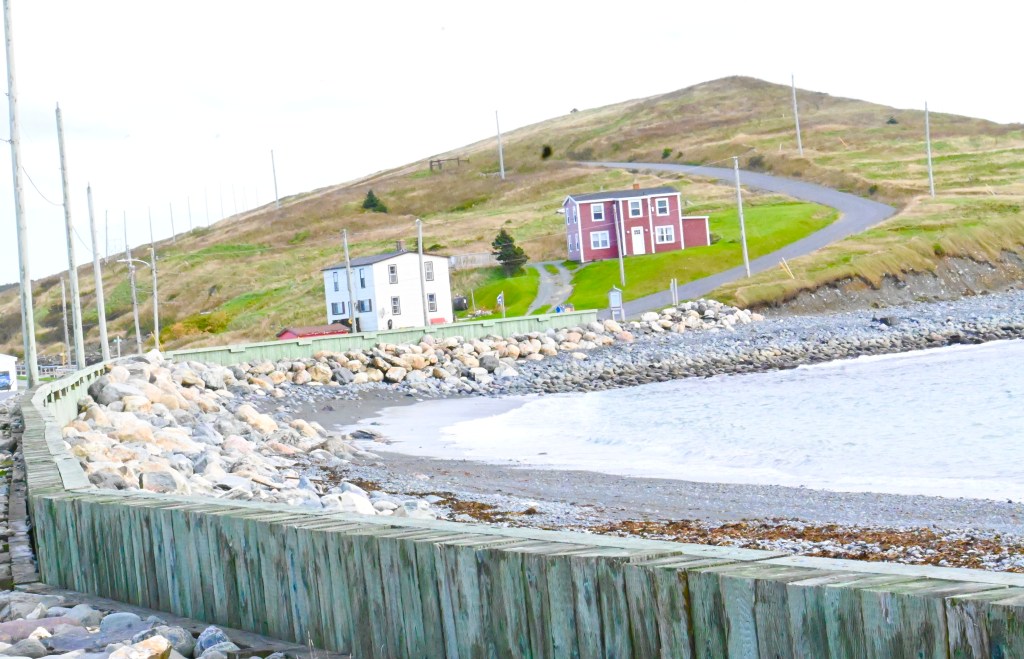
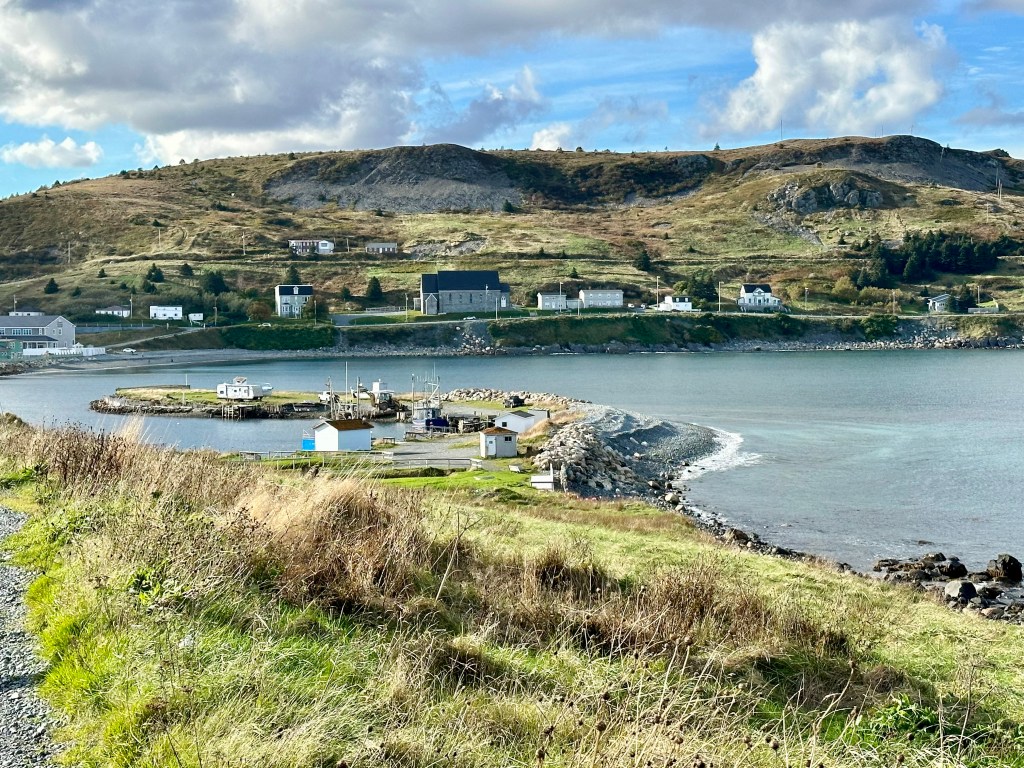
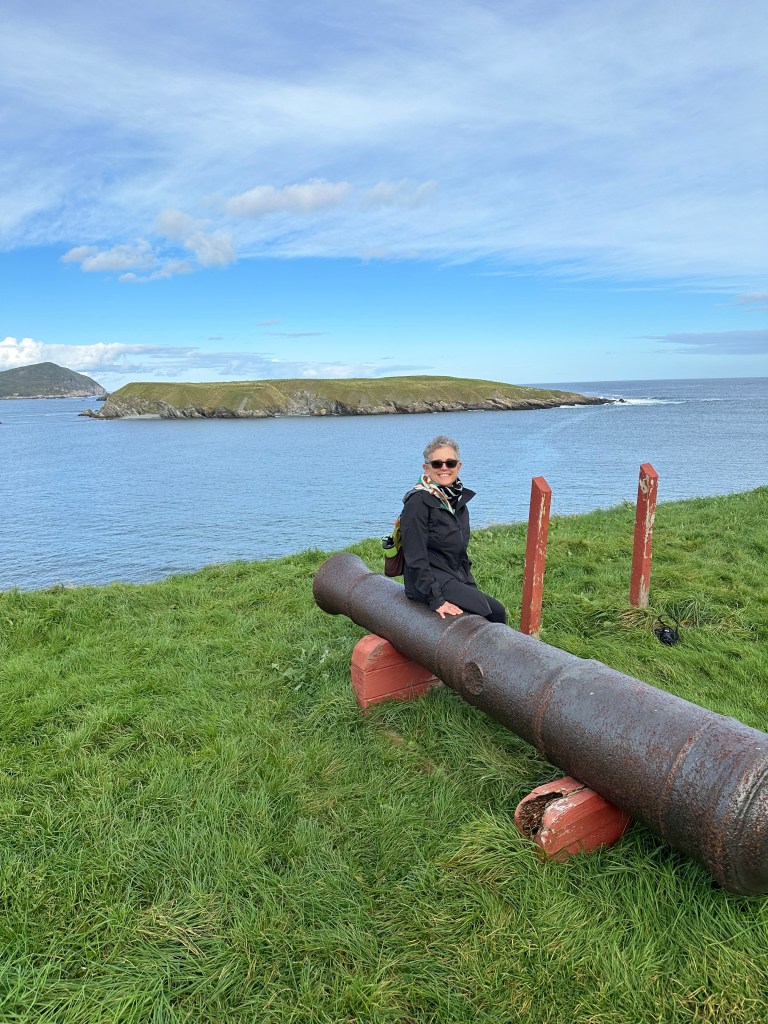
The walk was nearly empty of visitors and I walked slowly toward the lighthouse. The path is framed by a few simple clapboard structures—a community center, a house, a utility building. Like many wooden buildings in Newfoundland, they are brightly painted and weatherbeaten at the same time. I stopped by a relic of an ancient cannon to take pictures of furious waves crashing against the ever-present soaked cliffs. It is impossible in Newfoundland not to take such photos.
As I focused my lens, a middle-aged couple on a large motorcycle suddenly appeared next to me. “Ya know, there are sheep over there on that island” said the man, without any introduction, as if he were answering a question I had just posed. I turned to look at the couple, who both had friendly round faces creased into smiles. The man pointed to a nearby island that looeds like a beached stone whale coated with grass. Sure enough, the fluffy brown dots on the humpbacked island came into focus as grazing sheep. “They’re there for the summer,” said the man. “Where do they go in the winter?” I asked. He laughed, “Well, back in the barn, of course” pronouncing barn like “burn”, with that Newfoundland brogue that is three-quarters Irish, one-quarter Canadian. “The ones that don’t become mutton, that is”, he said, laughing again at his own joke.
They asked me why I had come to Newfoundland and I told them that my friend, a composer, had written an opera based on a book called February, about the sinking of the oil rig, Ocean Ranger. “Oh I heard about an opera in St Johns,” said the woman. And then she asked me if I had seen Come From Away. Reluctantly, I admitted that I had not. The couple had seen it in St Johns. “Did you think it was accurate?”, I asked. They both beamed, Oh yes, very accurate” and proceeded to tell me stories of other Newfoundlanders outside Gander, in small towns and large, who had also helped stranded travelers on 9/11.
They were not the first Newfoundlanders to bring up Come From Away. I got the sense that the whole province had breathed a collective sigh of relief that the first Broadway show about Newfoundland had portrayed them as they wanted to be seen – courageous, welcoming, and generous of spirit and heart. Not as the butt of jokes as I’ve been told happens in Canada, but as heroes. The ones who never fail to greet you warmly: “Lovely evening, isn’t it” “Sun coming out soon!”
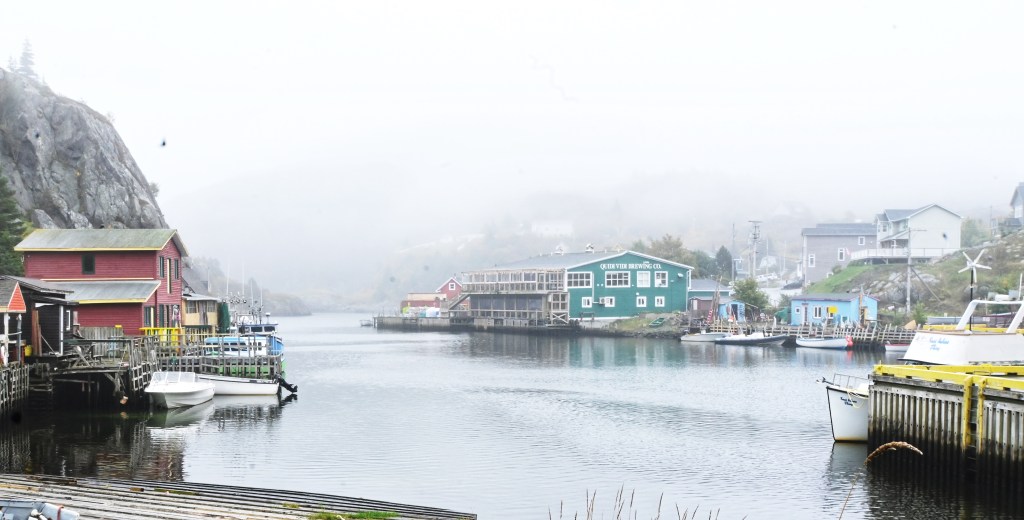
I had indeed come to Newfoundland to see an opera. A dear friend, Laura Kaminsky, had been commissioned by Opera on the Avalon, in St John’s, to compose and co-write an opera based on a book by Lisa Moore. The book, and the opera, address the kind of disaster too familiar to people whose lives depend on water—lives lost at sea, lives that were beholden, in this case, to corporate greed. [Here’s a review of the opera]

For three days, our band of opera-goers were guided around the Avalon by a garrulous and charming Newfoundlander named Ellis. Ellis kept running monologue that often took the form of a pop quiz: “Do you know how we say ‘it’s a beautiful day’ in Newfoundland?” (“some day on clothes”). “Do you know how we say ‘who are your parents?’ in Newfoundland?”(“who knit ya’?”) “What do you think “you’re a hard ticket, you are” means?”(you’re up to no good). “What do you think those painted wooden bins are for?” (to keep seagulls from eating out of the trash).
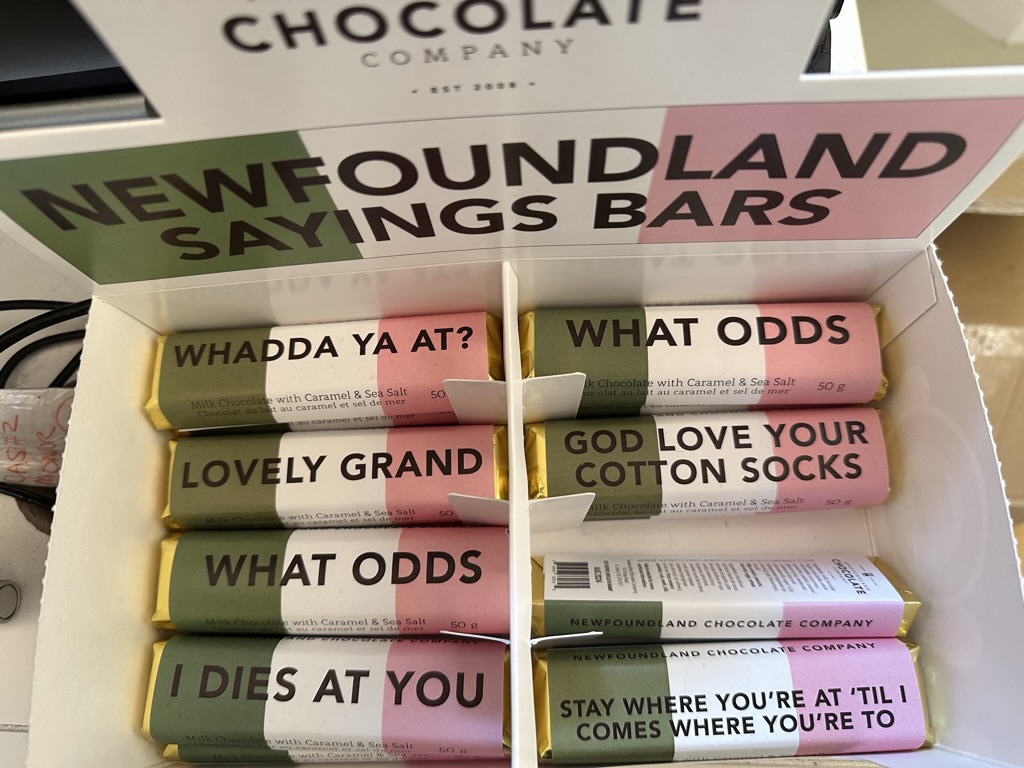

I did not know any of these things and spent four days coloring in a blank slate in my mind about the people who live in Newfoundland.


We learned about cod tongues and scrunchions (fried pork rinds) and the screech ceremony which initiates one as a Newfoundlander (Note: it involves kissing a cod). Ellis regaled us with tales of jiggers and folklore, of the “little people” and lucky charms, and recited a poem called Erosion when we were surrounded by cliffs etched by wind and water.
I sensed that Newfoundlanders know that you, the visitor, probably understand little about them and what you think you know just involves fishermen and stormy outposts battered by waves.
A neighbor of mine, whom I hadn’t previously known was from Newfoundland, saw my Instagram post and started texting me helpful messages: “If someone asks you to dinner at their house, say yes!” “Go visit Brigus and Colliers, it’s where my people are from”.

I did visit Brigus, a tranquil coastal town of simple and elegant clapboard homes, a simple white church overlooking the sea, a tunnel blasted through the rock in 1860 to facilitate access to a wharf. It made me think about those who still know where their people are from, a feeling that my family has simply lost.


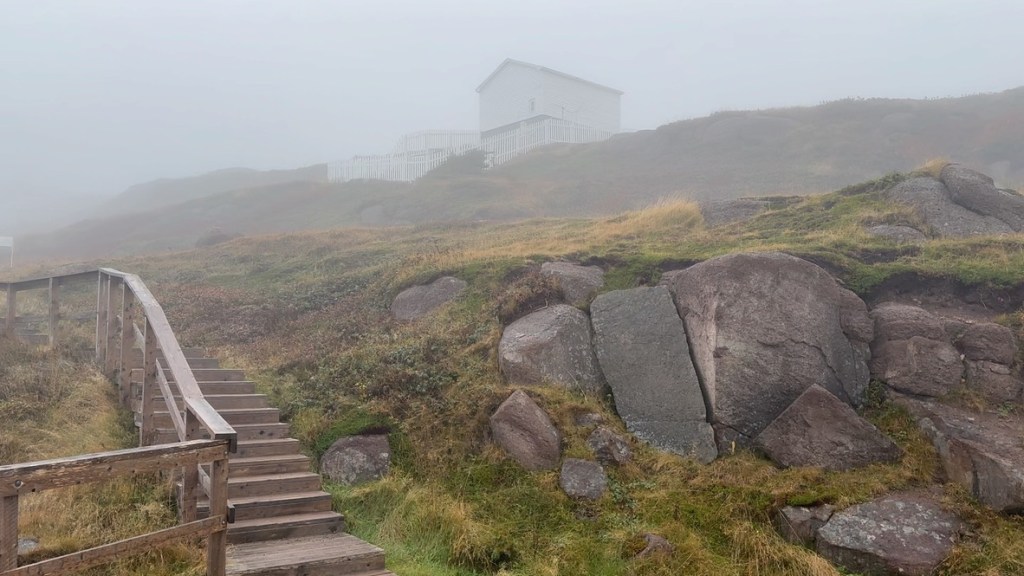
On our first day, Ellis took us out to Signal Hill in St John’s. Here the final battle of the Seven Year’s War was fought in 1762, forcing the French out of Newfoundland. And a century and a half later, Marconi stood there and received the first wireless transmission from England. A short way to the south is Cape Spear, the easternmost point in North America. That day, the dense fog hung over the water like a grey veil, obscuring the view to Ireland—I often felt that I was walking on a piece of Ireland that had floated over to North America. I could picture the boats arriving from Norway and England and Ireland to this New Found Land, hitting this rocky cape and rejoicing for having found solid ground.

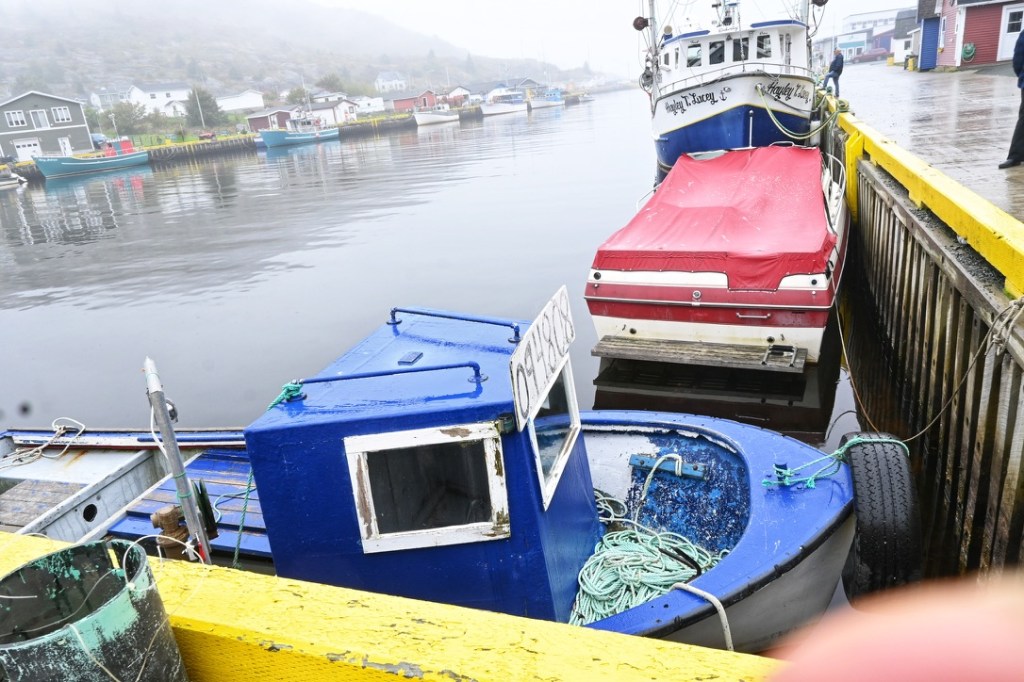
When I shared some photos of my trip with my sister, she said “just as I imagined it- austere.” And I pondered the word “austere” which tastes of denial and sacrifice. When I passed through a town like Ferryland I thought not of austerity but of simplicity, of essentiality. There is nothing built that doesn’t need to be there. A dock, a pier, lobster traps, a stone path. Even the colorful “jellybean” houses of St. John’s evoke a spare solidity.
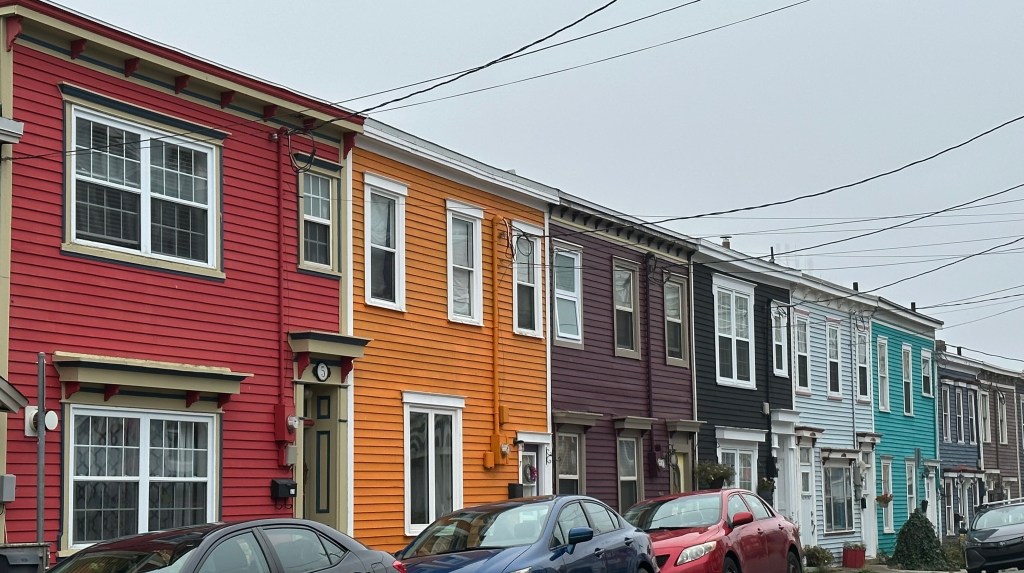

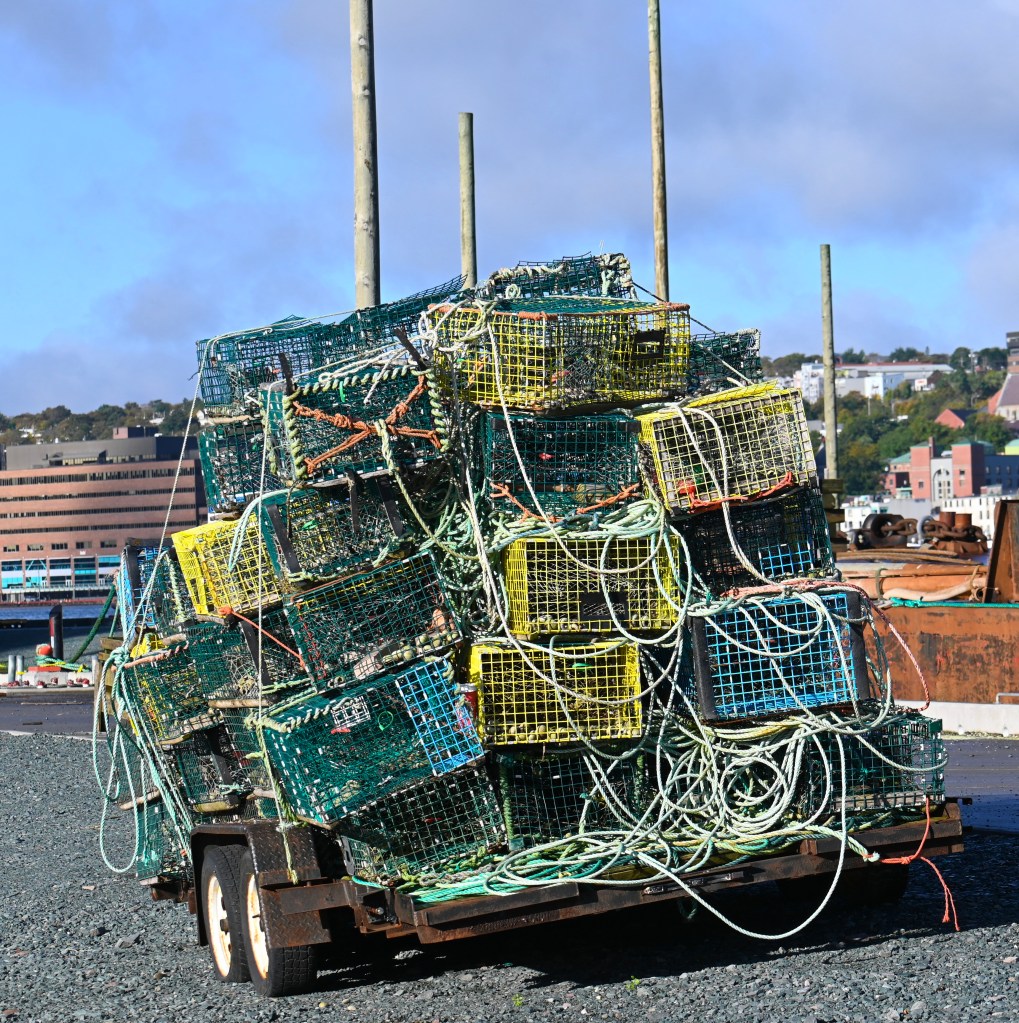
To live here means never escaping the elements. I spent much of my last day watching a storm roil the waves in my cliffside room in Tors Cove There’s no pretending that the water can’t be harsh or the winters fierce. One of the first things Ellis said to us was, “ya know in Newfoundland, we say there’s no bad weather, just bad clothes,” and I said, we say the same thing in the Adirondacks, where I live. I’m a newcomer to the Adirondacks too, and just as I have learned to wear the right clothes, so I sensed that perhaps, with time, I could begin to understand Newfoundlanders.
 Old and On the Way
Rather stark I’d say, and gorgeous, the shapes, the colors, the care put into each building. I’d love to go someday. Thanks for the education and photos!
LikeLiked by 1 person
Wonderful, Sharon! I so enjoyed your writing and photos!
Sent from my iPhone
<
div dir=”ltr”>
<
blockquote type=”cite”>
LikeLike