


Our Istanbul food tour guide, Kadir, leaned over the plate of baklava and commanded our attention. “There is a proper way to eat baklava, watch”, and he speared the sweet sticky square with his fork about a third of the way in and turned it over so the nutty layer was on top. “You listen for the crunch of the nuts, then you let the sweet syrup coat your palate and drip down your throat.” He took a reverent bite and closed his eyes rapturously.

We were in Güllüoglu, a pastry shop in the Karaköy neighborhood that is a veritable temple to baklava (which I learned to pronounce as bahk-LA-wah), It’s a lively crowded spot with an ebullient owner who promptly showed us a photo of him with Jill Biden.

And if you think you can just order “baklava”, you realize that would be like going into a Japanese restaurant and ordering “sushi”. I counted 28 kinds of baklava on the Güllüoglu menu, including chocolate baklava, palace roll with walnuts, Burma with walnuts, Midye with pistachio, Long-lasting with pistachio, vegan with walnut, gluten-free baklava, and Gelin Bocasi with walnuts. Clearly the Turks take baklava seriously.

But so do the Greeks and for me eating baklava never fails to bring back memories of glittering mounds of baklava piled high in the Arab shops in the Old City of Jerusalem. In this sweet and crunchy morsel lies the history of Anatolia and beyond. Wikipedia has a long entry on baklava, acknowledging that its roots are unknown but that it is claimed by Turks and Greeks and Persians and Arabs and Armenian with theories of its origins dating back to Homer. The earliest known reference to baklava is in a poem by the 15th century mystic Kaygusuz Abdal.

Türkiye has forever been a crossroads and you can taste it in the food. We started our Istanbul food tour in Karaköy, an incredibly lively neighborhood that was the historic port of Galata. Parts of Karaköy still evoke the overflowing markets and caravanserais (inns) of Byzantine and Ottoman times, parts of it that were once workshops and slaughterhouses are now classy cafes and restaurants and bars.

We started with the “commuter breakfast” of the ubiquitous simit (a kind of large sesame covered bagel) and string cheese, perched on folding chairs in an old han, or workshop area.

We then moved on to breakfast #2, seated on benches covered with brightly colored textiles—this time adding olives—black olives puckered in oil, large green olives stuffed with almonds, soft cheese, soft round buns, marinated oregano, spicy red pepper spread, the Turkish version of pastrami. It’s the food I associate with this part of the world. Though this is my first time in Türkiye, it feels familiar and almost like comfort food.


After our baklava stop, we headed for the ferry over to the Asian side of Istanbul, to the neighborhood of Kadiköy. On the way, we grabbed spinach-filled gözeme, the flat bread fried on a large round half-moon griddle –cooked exactly as fresh corn tortillas are made in Mexico.
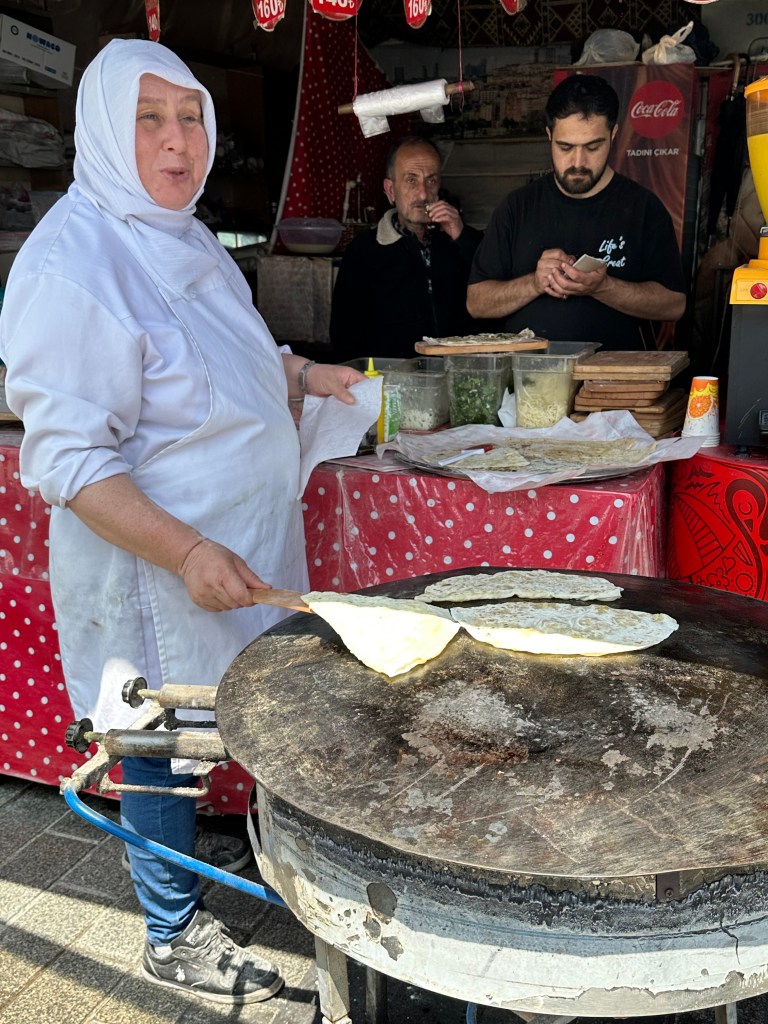
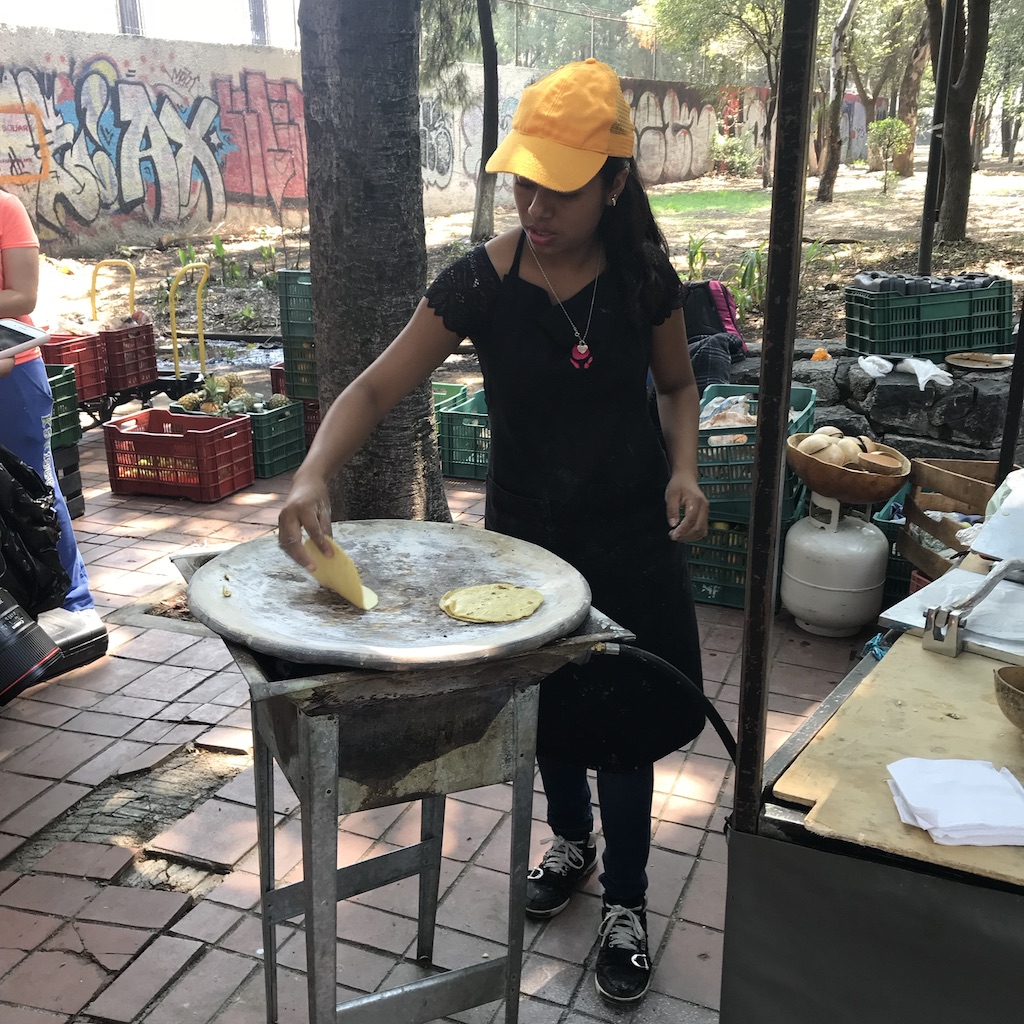
Like Karaköy, Kadikoy is humming with people and packed with cafes. Kadir lead us toward a homey restaurant on a quiet street. Along the way, he points to a Chinese restaurant called “Wok Shop”. See, he says, its empty. And look, next to it, the restaurant with traditional Turkish food, it’s crowded! The people are happy! and smiling! Turks had once been enamored of foreign food, he said, and Istanbul had been full of Mexican and Asian restaurants but now, he said, Istanbullers are rediscovering their food roots.
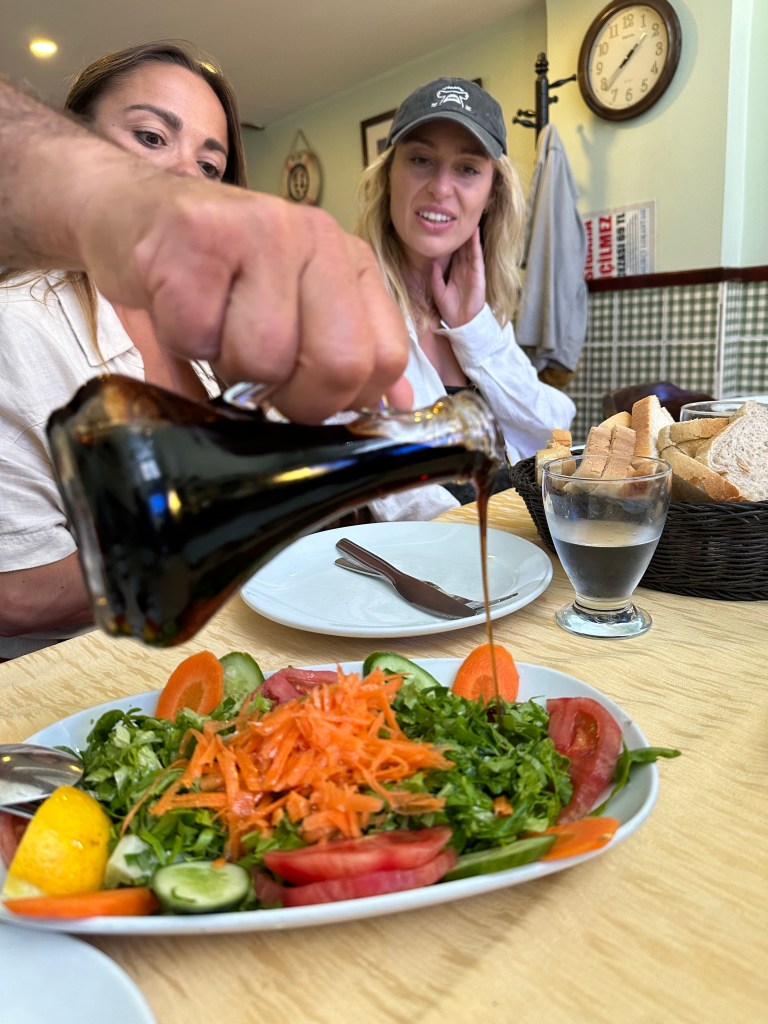
Though still full from breakfast, we fit in two more stops in Kadiköy. The first, a fish restaurant, introduced us to the meal we would have many more times in Türkiye— fish, fish and more fish (here, sardines and horse mackerel, floured and fried, scorpion fish in a stew), accompanied mounds of salad of chopped lettuce, tomato and onions, sprinkled with fresh dill and mint. Kadir deftly dribbled pomegranate molasses over the salad with the same skill with which he nibbled baklava.

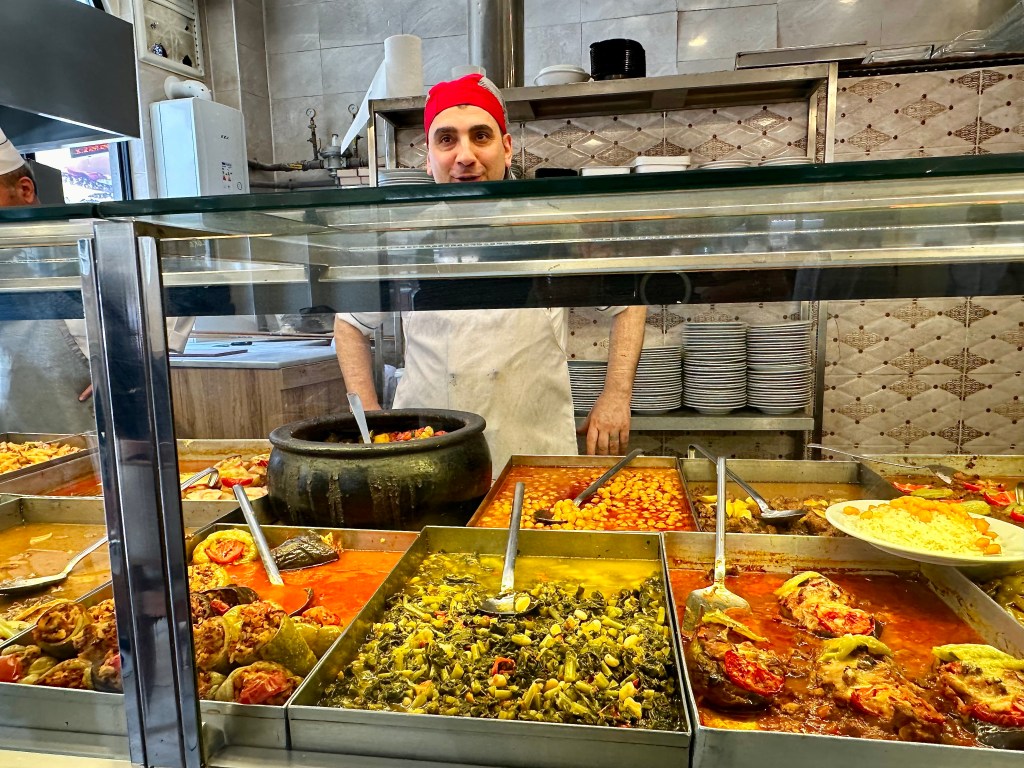
We ended the Istanbul food tour (this was the Two Markets tour offered by Culinary Backstreets) in tiny luncheonette specializing in another dish that, like baklava, symbolizes the ancient globalization of food– in Türkiye, pilav (or rice pilaf to us English speakers). As Wikipedia notes: At the time of the Abbasid Caliphate, such methods of cooking rice at first spread through a vast territory from India to Greece, and eventually to a wider world. The Valencian (Spanish) paella, and the Indian pilau or pulao, and biryani, evolved from such dishes. I had pilau in Uzbekistan that was filled with vegetables and meat (including horse meat, no thank you, but otherwise delicious) but in Türkiye, the pilav tends to be simpler, drenched in oil (yum) and often with nuts added. Later, I had pilav made with rice noodles rather than rice grains. Clearly the word “pilav” is broad enough to cover multitudes of rice dishes.

Pete and I would leave Istanbul to spend five days in a far less populated part of Eastern Anatolia, basing ourselves in Kars and also spending two nights in small inns in the Trans-Caucasus Mountains. This region is far from the tourist hordes and cruise ships of the western coast. There are no Michelin rated restaurants but what you can get is freshly-caught trout fried or grilled and accompanied by that same fresh mound of salad and freshly baked soft bread. I don’t think I’ve ever eaten more healthfully.


The Kars region is also known for its cheese, especially the Kars gruyere, which is sharp and almost crumbly and delicious.

We had treated ourselves to a Michelin starred restaurant in Istanbul (Mikla, I will forever dream about the pistachio cake topped with basil ice cream ) and I had noticed Kars gruyere on the menu.

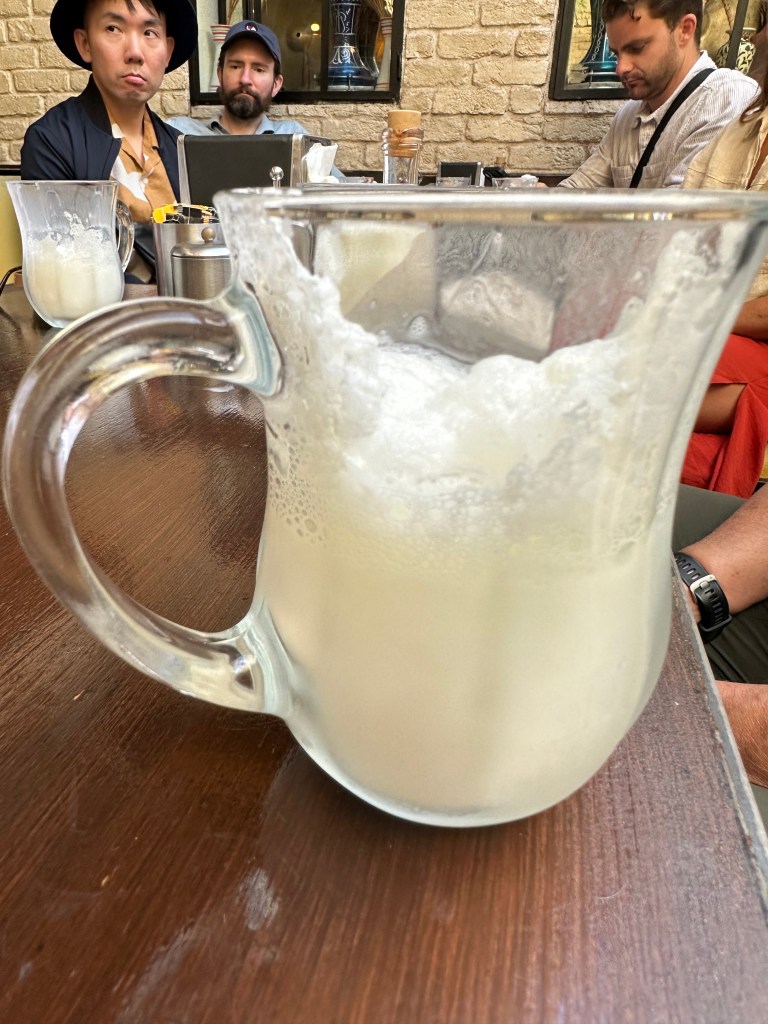
Dairy products are essential to daily life in Türkiye. Not just cheese but especially yogurt-based food. Both Kadir in Istanbul and Celil, our Kars-based guide, touted the health benefits of eating fermented foods like yogurt (probiotics!) and picked cabbage (Celil: I always drink a tablespoon of vinegar each day when I travel). Kadir had introduced us to ayran, a summertime drink made with yogurt, water and salt (think salty keffir-Kadir said you have to grow up with it) and later we were treated to a warm yogurt soup laced with pepper and dill, which I admit I liked much better than ayran.


I can’t end a commentary on eating in Türkiye without mentioning the drink that does seem to be the lifeblood of Turkish life – tea, here called çay (pronounced “chai”). As I had long known about Turkish coffee, I had assumed that coffee would be the drink of choice, but no, it is çay that is everywhere. Kadir had a theory about the word “çay”—essentially the same word for tea from China to India to Türkiye. His theory was that as tea made its way across land from China to India to the Mediterranean, it retained the “chai” pronunciation. But when Europeans arrived in China and shipped it across the oceans to Europe, it became “tea” and all its variants. Who knows? It sounds like a good theory and one that reflects the complete universality of tea.

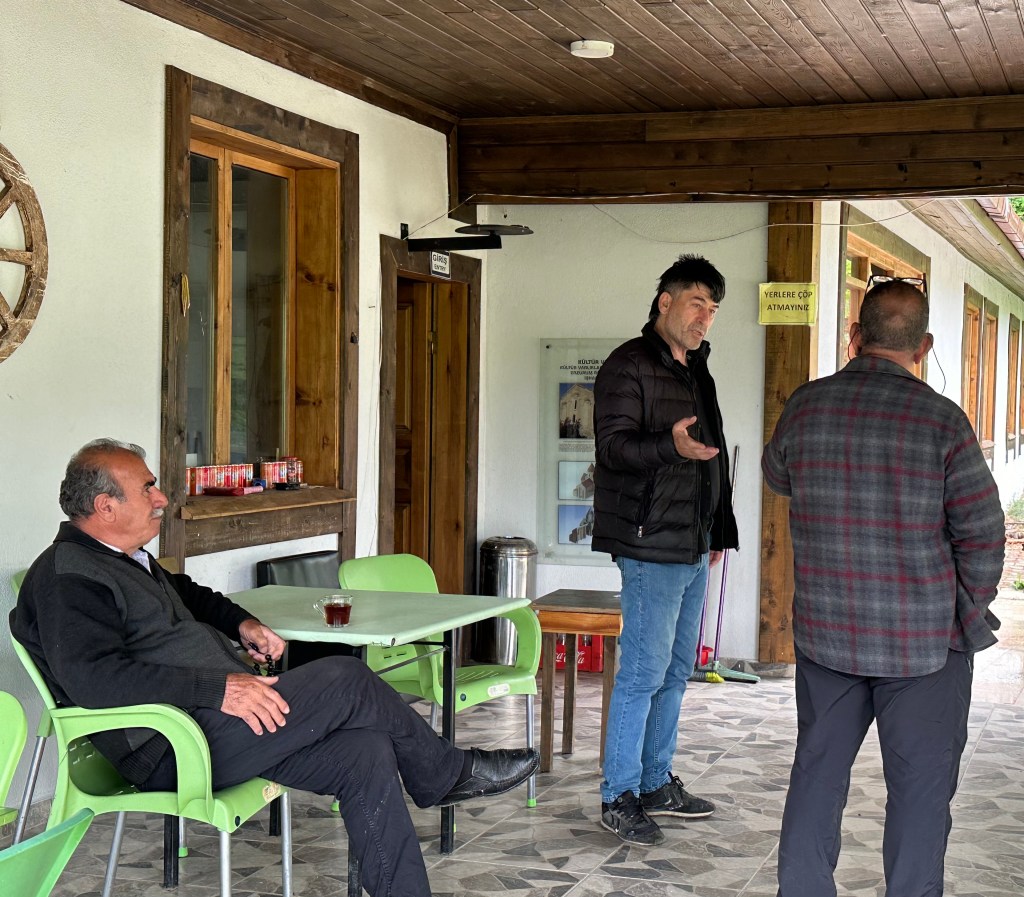
What I do know is Turks don’t drink tea the way Americans drink coffee—in big slurpy to-go cups and on the run. Never. Drinking tea is a social ritual. During our five days in Eastern Anatolia, almost every stop was an opportunity to sit, chat with a local, and drink some tea. Wherever you go, you are offered tea. Always in the same small fluted glass, always on a small decorated saucer. Always a time to sit, take a rest, and appreciate life.
 Old and On the Way
I think you were born to write food travel blogs, Sharon. This was wonderful!
LikeLike
Thanks! Hope you get to eat all this on your next trip to Türkiye 😋
LikeLike
the food looks outstanding and the descriptions were mouthwatering .
beautiful scenery and great food.
👍😋💕
LikeLike
Oh, I’m glad I finally got to read this. It may be as close to that region as I ever get. Sumptuously told, and I’m hoping you have some coming up blog with the rest of your trip, since I’m rather full from this reading but want to hear MORE! What an exquisite journey!
LikeLiked by 1 person
Thanks Nancy. It was indeed a feast for the senses. I’m still processing all that I learned there, well beyond food…
LikeLiked by 1 person
I’ll bet. From your FB posts it looked completely immersive and amazing.
LikeLike